
3 min read ·
Poker Hand Probabilities: The Exact Numbers
Exact probabilities for every five-card poker hand, the best hand from seven cards in Texas Hold’em, and common draw calculations.
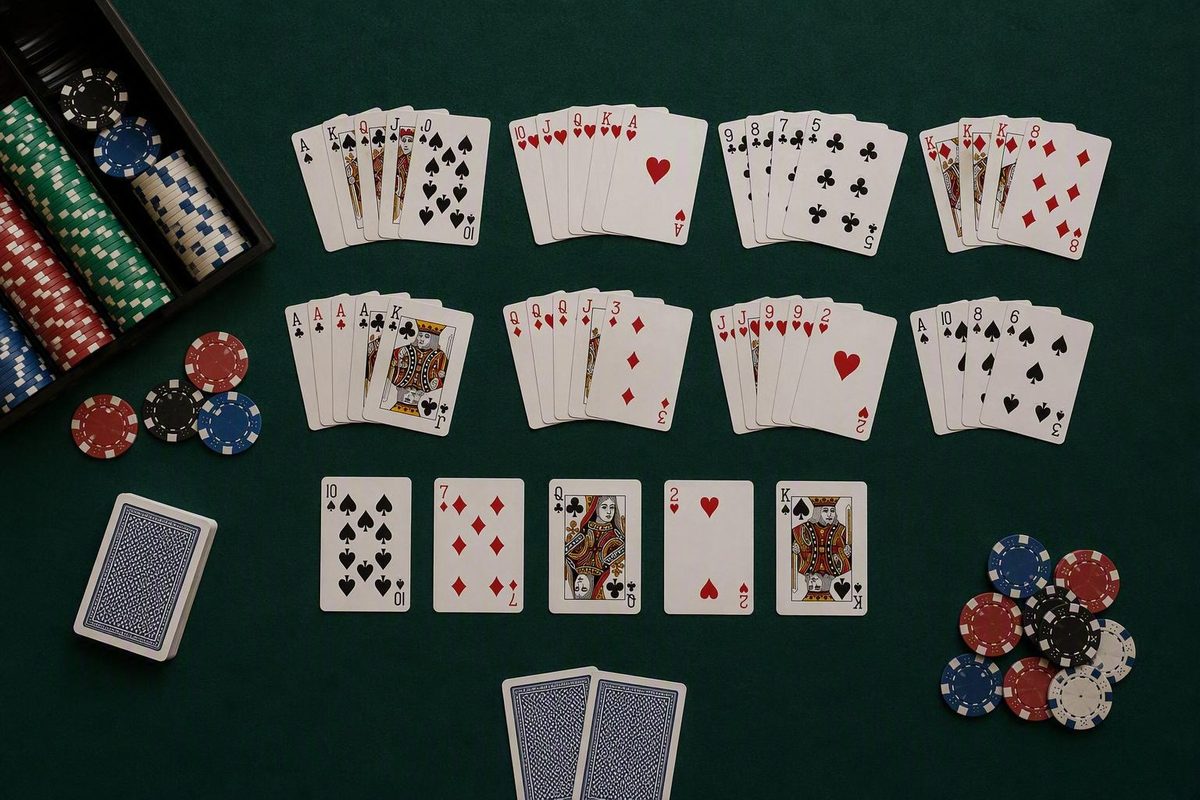
The probability of a poker hand depends on what is being counted. A random five-card deal is not the same experiment as a Texas Hold’em hand that reaches the river, where the player chooses the best five cards from seven.
The tables below assume a standard 52-card deck, no jokers and no known cards. Every category is exclusive: a straight flush is not also counted as a flush, for example.
Probability of each hand in a five-card deal
There are
\binom{52}{5} = 2,598,960
distinct five-card combinations. The University of Hawaii’s published counts and probabilities give the following complete distribution for mutually exclusive hand categories (University of Hawaii Department of Mathematics).
| Best five-card hand | Combinations | Probability | About 1 in… |
|---|---|---|---|
| Royal flush | 4 | 0.0001539% | 649,740 |
| Straight flush, excluding royal | 36 | 0.001385% | 72,193 |
| Four of a kind | 624 | 0.02401% | 4,165 |
| Full house | 3,744 | 0.1441% | 694 |
| Flush, excluding straight flush | 5,108 | 0.1965% | 509 |
| Straight, excluding straight flush | 10,200 | 0.3925% | 255 |
| Three of a kind | 54,912 | 2.1128% | 47.3 |
| Two pair | 123,552 | 4.7539% | 21.0 |
| One pair | 1,098,240 | 42.2569% | 2.37 |
| High card | 1,302,540 | 50.1177% | 2.00 |
The arithmetic is simply
P(hand) = number of qualifying combinations ÷ 2,598,960.
For four of a kind, choose one of 13 ranks for the quads and then one of the remaining 48 cards as the kicker:
13 × 48 = 624, \qquad P(quads) = 624 ÷ 2,598,960 = 0.02401\%.
A royal flush has only four combinations—one per suit—so its probability is 4/2,598,960, or one in 649,740. The royal-flush breakdown examines how that figure changes in Hold’em and at a full table.
Texas Hold’em probabilities by the river
In Hold’em, each player receives two private cards and can combine them with five community cards to make a five-card hand (WSOP). Before any cards are known, that means evaluating the best five-card result among \binom{52}{7}=133,784,560 possible seven-card sets.
The resulting distribution is (Bill Butler’s seven-card enumeration):
| Best hand available from seven cards | Combinations | Probability |
|---|---|---|
| Royal flush | 4,324 | 0.003232% |
| Straight flush, excluding royal | 37,260 | 0.027851% |
| Four of a kind | 224,848 | 0.168067% |
| Full house | 3,473,184 | 2.596102% |
| Flush, excluding straight flush | 4,047,644 | 3.025494% |
| Straight, excluding straight flush | 6,180,020 | 4.619382% |
| Three of a kind | 6,461,620 | 4.829870% |
| Two pair | 31,433,400 | 23.495536% |
| One pair | 58,627,800 | 43.822546% |
| High card | 23,294,460 | 17.411920% |
These are unconditional deal frequencies, not the chance that a particular starting hand improves and not the chance of winning against an opponent. They also will not match observed showdown frequencies: players fold, so many dealt hands never reach the river or get revealed.
The probability of completing a draw
Once cards are visible, count the unseen cards that complete the hand—usually called outs—rather than using the unconditional tables.
Suppose you hold two hearts and the flop contains two more. Nine of the 13 hearts remain among 47 unknown cards. Assuming every heart is a clean out, the exact chance of completing the flush by the river is
1-(38 ÷ 47 × 37 ÷ 46) = 34.97\%.
This complement method counts the chance of missing on both remaining cards and subtracts it from 1; Cornell’s probability lesson gives the same setup and approximately 35% result (Cornell University). With only the river to come, the calculation is instead 9/46=19.57\%.
An out is not necessarily a winning out. A card that completes your straight might also complete an opponent’s flush, and paired boards can make apparently useful flush cards dangerous. Hand probability therefore differs from equity, which is your share of the pot given opponents’ possible holdings. Neither number alone decides whether a call is sound: that comparison also requires the price supplied by the pot.