
3 min read ·
Han Feng’s Aces Were 92.93% to Win on the Flop
Exact flop and turn odds for Han Feng’s pocket aces against Lauri Saaskilahti’s nines at the 2026 WSOP Main Event final table.
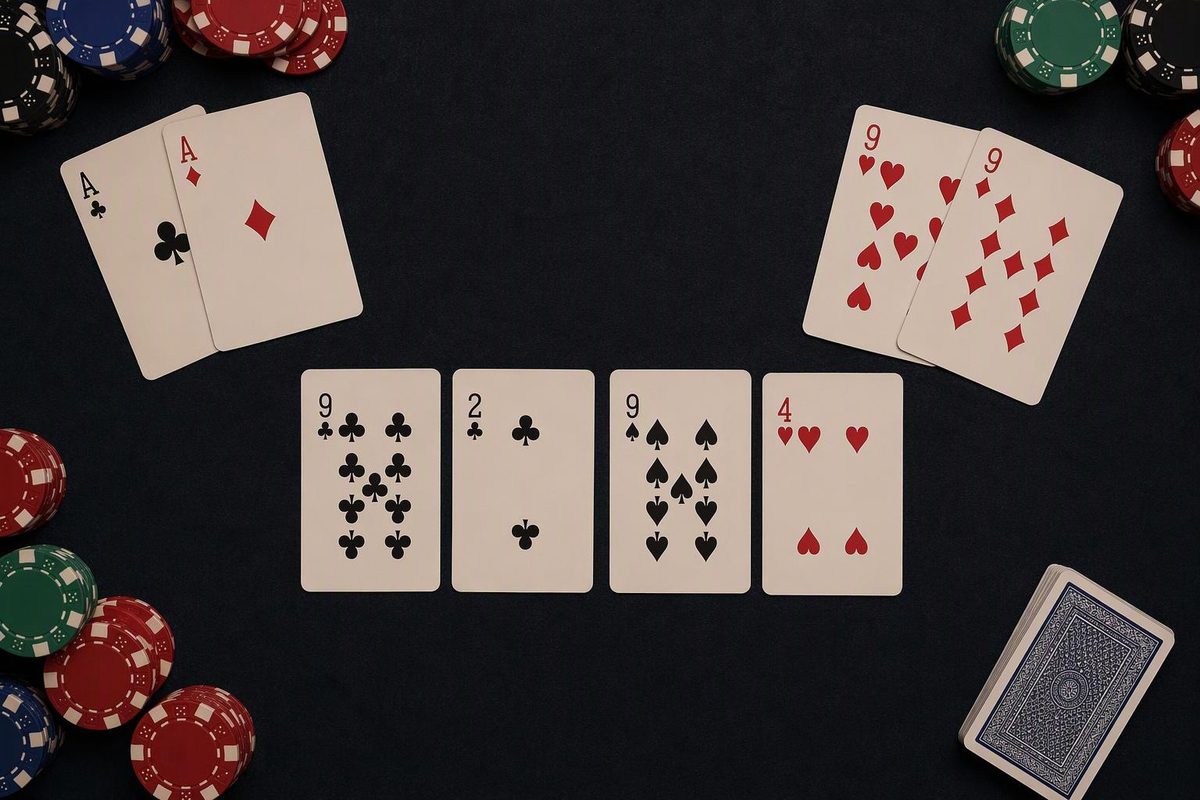
Han Feng’s pocket aces had 92.93% equity on the flop against Lauri Saaskilahti’s pocket nines in their decisive 2026 WSOP Main Event hand. Under the usual calculation using the two live hands and the exposed board, the chance of Feng’s aces being cracked from that flop was 7.07%, or about 1 in 14.1.
The hand was:
- Feng: A♦ A♣
- Saaskilahti: 9♠ 9♥
- Flop: 10♦ 8♦ 3♦
Feng held both the overpair and the ace-high flush draw. After the J♥ turn, however, Saaskilahti gained an open-ended straight draw. The Q♠ river completed his straight and eliminated Feng in fifth place. The cards and action are documented by ESPN’s final-table report and PokerNews’ account of the elimination.
Flop odds: aces win 920 of 990 runouts
Seven cards were known on the flop: four hole cards and three community cards. That left 45 unseen cards and:
\binom{45}{2} = 990
possible unordered turn-and-river combinations.
Saaskilahti could win on 70 of them.
43 combinations involving another nine
If the 9♣ arrived, 34 companion cards produced a win for the nines. Feng survived only when the other card was one of eight non-nine diamonds, completing his flush, or one of the two remaining aces.
The 9♦ completed Feng’s flush, but it still won for Saaskilahti when accompanied by any of the nine non-diamond cards pairing the 10, 8 or 3 on the board. Those runouts gave the nines a full house. These add nine combinations not already counted with 9♣.
That makes 43 winning combinations involving a nine.
27 running-straight combinations
Without hitting a nine, Saaskilahti could make a straight with three turn-river rank pairs:
- 6 and 7
- 7 and jack
- jack and queen
A diamond in any of those combinations would instead complete Feng’s ace-high flush. Each rank therefore had three usable non-diamond suits:
3 × 3 = 9
winning combinations per rank pair, or 27 altogether.
The complete result is:
P(99 wins) = 43 + 27 ÷ 990 = 7.0707\%
P(AA wins) = 920 ÷ 990 = 92.9293\%
There were no tied runouts. This supports Card Player’s description of Feng as just shy of a 93% favorite.
Turn odds: seven winning rivers for the nines
The J♥ changed the calculation substantially. With 44 unseen cards remaining, Saaskilahti had seven winning rivers:
- Q♣, Q♥ or Q♠
- 7♣, 7♥ or 7♠
- 9♣
The Q♦ and 7♦ would make Feng’s flush. The 9♦ would also put a fourth diamond on the board, so only the 9♣ was a winning set card.
Thus:
P(99 wins) = 7 ÷ 44 = 15.9091\%
P(AA wins) = 37 ÷ 44 = 84.0909\%
The river was the Q♠—one of those seven outs.
What if the folded jacks are treated as known cards?
Greg Mueller folded J♣ J♦ before the flop. Television viewers knew those cards, but the two active players did not. The 92.93% figure therefore describes equity from the players’ shared information: their live hands and the exposed board.
A viewer can instead condition the calculation on both jacks being dead. That leaves 43 unseen cards and:
\binom{43}{2} = 903
possible runouts. Removing the J♣ eliminates seven of Saaskilahti’s winning combinations: one with the 9♣, three with a seven and three with a queen. The J♦ was not part of a winning runout because it would give Feng the ace-high flush.
Saaskilahti therefore wins 63 of 903 runouts, making his chance 6.98% and Feng’s 93.02%. The distinction is small here, but it shows why an odds figure should state whether folded broadcast cards have been removed from the deck.
Hand equity was not payout equity
Feng’s 92.93% was the probability of winning this pot from the flop—not his probability of winning the tournament or a guaranteed dollar value.
Card Player estimated that winning the hand would have left him with 57.5 million chips worth more than $4.5 million under an independent chip model, compared with his actual $2.25 million fifth-place payout. That difference compares two possible outcomes; it is not, by itself, Feng’s ex ante expected-value loss. A tournament-value calculation made before the remaining cards were dealt would have to weight every possible outcome and apply ICM to the resulting stacks.
The official WSOP result confirms Feng’s fifth-place prize. Lucas Jumalon ultimately defeated Saaskilahti heads-up for the $10 million first prize.