
3 min read ·
2026 WSOP Shot Clock Rules: What Applied at Each Stage
The 2026 Main Event used a shot clock on Days 7–8, then removed it for the final table. See the reported time limits and Rule 80 clock-call procedure.
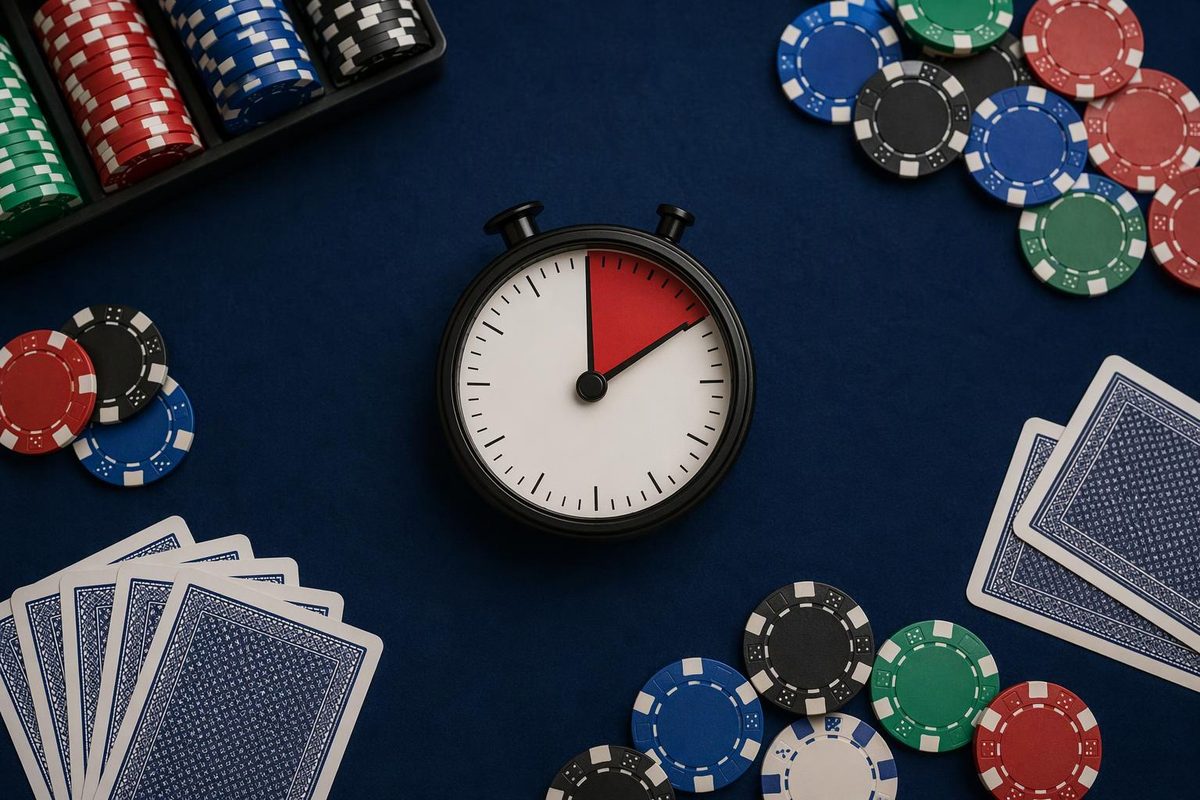
The 2026 WSOP Main Event used an automatic shot clock on Days 7 and 8, but removed it for the nine-player final table, according to PokerNews’s final-table report. The timed format allowed 20 seconds preflop and 30 seconds postflop, with time-extension chips available.
That was a Main Event decision—not a blanket 20/30-second rule for every 2026 WSOP tournament. The general rule to distinguish from it is Rule 80, “Calling-for-clock,” in the official Las Vegas tournament rules.
Which format applied in the Main Event?
| Stage | Decision-time format |
|---|---|
| Days 1–6 | No automatic event-wide shot clock; ordinary clock calls remained available. |
| Days 7–8 | Automatic shot clock: 20 seconds preflop, 30 seconds postflop, with extensions. |
| Nine-player final table | Automatic shot clock removed; players and tournament staff could still call the clock. |
Tight Poker’s July 31 report describes timed play on Days 7–8 and reproduces WSOP’s announcement removing the clock for the final table. PokerNews likewise places implementation before Day 7.
The reported trigger was Loren Klein taking 15 minutes over a Day 6 decision. PokerListings’s July 13 account places implementation at the start of Day 7 and reports an allocation of six 30-second time banks per remaining player for postflop decisions.
Six such extensions represent:
6 × 30 seconds = 180 seconds, or three minutes of additional thinking time.
That is the reported extension allocation—not three minutes for every decision. Nor should it be confused with the regular 30-second postflop allowance. A replenishment schedule is not established by these reports, so do not assume six fresh extensions on every hand or betting round.
How Rule 80 clock calls worked
Under the official 2026 WSOP Tournament Rules, Rule 80, once a reasonable amount of time has passed and a clock is called:
- Floor staff may allow zero to 25 additional seconds, at their discretion.
- If the player still has not acted when prompted, a five-second countdown follows.
- If the player does not act before the declaration or alarm, the hand is dead.
At the maximum allowance, that is 25 + 5 = 30 seconds after the clock is imposed. It is not a guaranteed 30-second allowance from the moment action first reaches the player, and staff may shorten it.
Rule 80 also permits an intentional staller to be placed on a clock for all subsequent decisions. Unnecessary clock calls or stalling—including deliberately exhausting time banks to reach a higher payout—can lead to a reduced clock or penalties. Rule 82 requires a player to be at their seat to call the clock. Official rules
Could WSOP introduce or restore a shot clock?
Yes. Rule 80 expressly reserves the host properties’ discretion to introduce an event-wide player shot clock at any point in a tournament’s structure. It authorizes implementation; it does not itself impose the Main Event’s 20/30-second settings across the series. Official rules
In the final-table statement reproduced by Tight Poker, WSOP retained the option to restore a shot clock if repeated or excessive stalling harmed the pace of play. Removing the automatic clock therefore did not remove enforcement against unreasonable delays.
Other 2026 WSOP events
For a tournament other than the Main Event, check its own structure sheet and any subsequent tournament announcements rather than borrowing the Main Event timeline. For example, the official 2026 structure document explicitly lists a 20-second preflop and 30-second postflop shot clock for Event #7, the $25,000 Heads-Up No-Limit Hold’em Championship. Event-specific timing and the general Rule 80 clock-call procedure are separate parts of the rules.