
4 min read ·
Poker Odds Questions: Draws, Percentages and the Price of a Call
Answers to common poker odds questions, with exact flush-draw calculations and a worked example separating probability, equity and expected value.
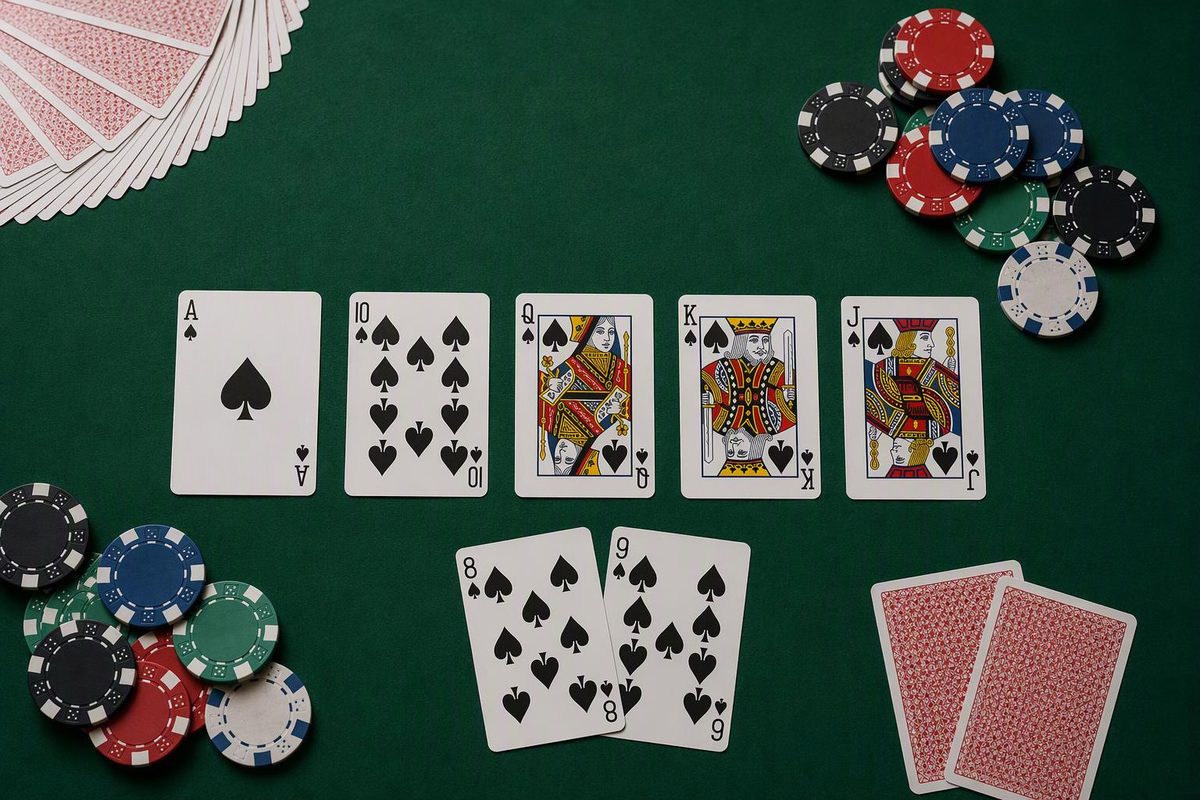
A poker odds question needs three details: what outcome you mean, which cards are known, and how many cards remain to come. The chance of making a flush is not necessarily the chance of winning, and neither tells you whether a call is worth its price.
These questions cover the distinctions that matter at the table. The examples use Texas hold’em with a standard 52-card deck without jokers.
1. Does “1 in 5” mean the same thing as “5 to 1”?
No. A 1-in-5 chance is a probability of 20%: one success for every five trials on average. The corresponding odds against are 4:1—four failures for each success.
For probability p:
- Percentage: 100 × p
- One-in frequency: 1 ÷ p
- Odds against: (1 − p) ÷ p, expressed as a ratio to 1
Always label the format. “Five to one against” means a 1-in-6 chance, or about 16.67%, not 20%. These are long-run proportions, not a schedule guaranteeing when a hand will arrive.
2. What are the odds of being dealt pocket aces?
There are 1,326 possible unordered two-card hands: 52 × 51 ÷ 2. Six contain two aces: 4 × 3 ÷ 2.
So the probability is:
6 ÷ 1,326 = 1 ÷ 221 ≈ 0.4525%
That is 1 in 221 deals, or 220:1 against, for one player before any cards are known. It is not the probability that someone at an entire table receives aces, nor the probability that aces win.
For other starting points and made-hand frequencies, see our poker hand probability tables.
3. What are the odds of completing a flush draw?
With two cards of one suit in your hand and two more on the flop, you have four of that suit visible. Nine remain unseen. Those nine cards complete your flush; whether they also win the pot is a separate question. PokerNews explains this out count and the need to discount cards that also give an opponent a stronger hand.
Assuming no additional cards are known and treating the unseen cards as equally likely to arrive, the exact probabilities are:
| Starting point | Calculation | Chance of completing the flush |
|---|---|---|
| Flop, next card only | 9 ÷ 47 | 19.15% |
| Flop, by the river | 1 − (38 ÷ 47 × 37 ÷ 46) | 34.97% |
| Turn, after a non-flush card | 9 ÷ 46 | 19.57% |
The two-card calculation subtracts the chance of missing twice from 100%. The denominators count unseen cards, not merely cards physically left in the dealer’s deck. Information about an opponent’s likely holdings can change the estimate.
The familiar rule of 2 and 4 estimates these chances by multiplying outs by two for one card or four for two cards. It is a shortcut, not an exact calculation. The Poker Bank’s comparison tables show the differences.
4. How do I know whether the pot offers enough to call?
For a cash-game decision with no rake or further betting, use call amount ÷ final pot after your call to find the break-even equity. Your call belongs in that denominator. The Poker Bank explains both the percentage and ratio methods.
Suppose the pot is $100 before your only opponent moves all-in for $25 on the turn. Calling $25 makes the final pot $150:
Required equity = $25 ÷ $150 = 16.67%
Now use a simplified flush-draw model: each of the 46 unseen cards is equally likely, all nine flush cards win, every other river card loses, and there are no ties. Your equity is then 9 ÷ 46, or 19.57%, above the threshold.
The call’s expected value relative to folding is:
EV = (9 ÷ 46 × $150) − $25 ≈ +$4.35
Equivalently, you gain $125 when you win and lose $25 when you miss. Money you previously contributed to the pot is not a new cost of this decision. Expected value weights each possible net result by its probability.
That is an average under the stated model—not the result of this particular hand. If some flush cards lose, the model overstates your equity.
5. Can I always use flop-to-river odds when facing a flop bet?
No. A flop call may buy only the turn; another bet may be required to see the river. Comparing a two-card probability with a one-street price leaves out that potential cost. The Poker Bank specifically identifies this mistake.
For an all-in decision that guarantees both remaining cards, flop-to-river equity is appropriate. Otherwise, account for future betting rather than treating the river as free.
Keep the three quantities separate: probability measures an event, equity measures your expected share of the pot at showdown, and expected value measures the average net result of a decision. A tie contributes only a partial pot share; our split-pot guide explains why that matters.