
5 min read ·
How Poker Pots Split and Who Gets Each Share
See when poker hands tie, how main and side pots are divided, who receives odd chips, and why a split counts as only a partial share of your equity.
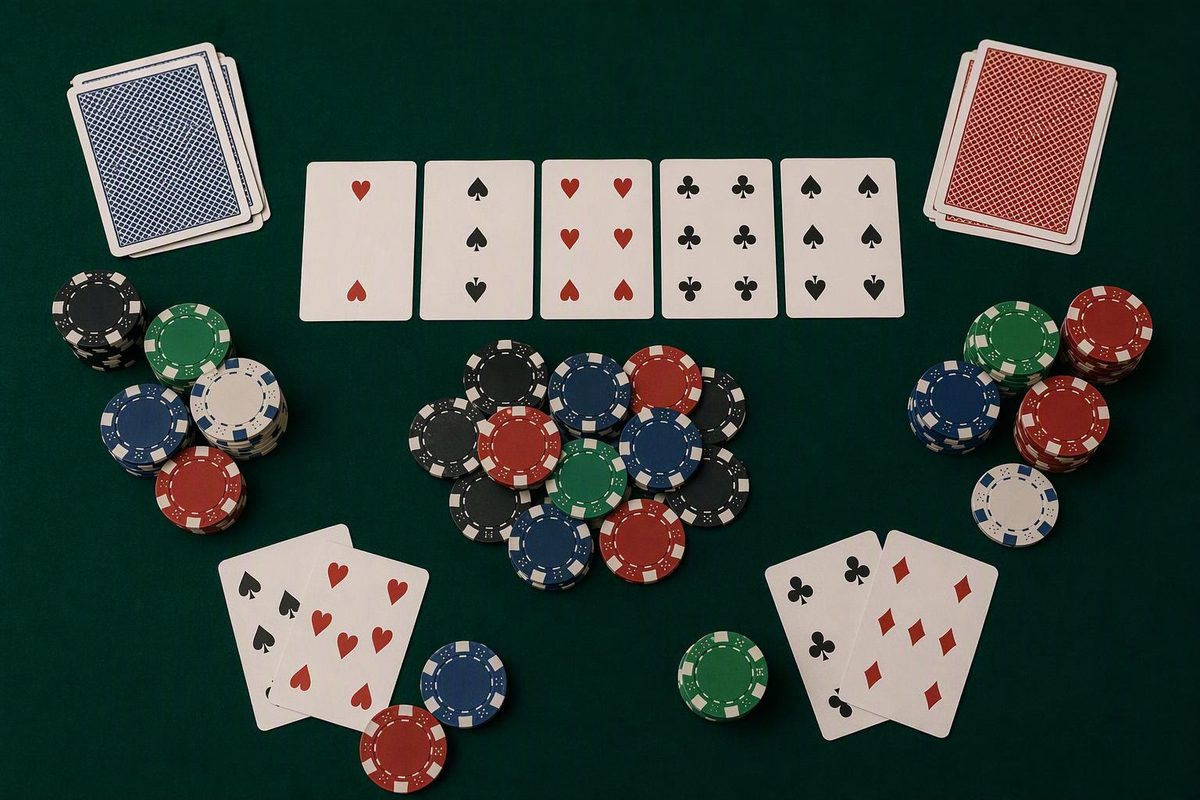
A split pot is a pot divided between players rather than awarded entirely to one. In Texas hold’em, two or more eligible players split a pot when they tie for the best five-card hand at showdown. Two tied winners normally receive half each; three receive one-third each, subject to indivisible chips. Having the same pair is not enough: the remaining cards in the five-card hand must also tie. Card Player’s poker rules explain this distinction.
In high-low games, a split pot can instead mean dividing the pot between the best high hand and the best qualifying low hand. Those hands need not be equal in rank. Either way, a share of the pot is not the same as winning it outright.
Enter your heads-up win and tie probabilities to calculate your expected share of one high-only pot.
Heads-Up Pot Equity
Expected share of the pot
40%
30% + ½ × 20% = 40%
Remaining loss probability: 50%.
Valid heads-up probabilities.
One heads-up, high-only pot; ignores rake and odd chips. Enter probabilities, not card counts. This does not calculate odds from your cards.
Source: the article’s hypothetical 30% win / 20% tie example and equity formula. Default values are illustrative, not measured hand odds.
Hold’em Ties Depend on the Best Five Cards
Compare each player’s best five cards, not their hole cards alone. Hold’em allows a player to use both hole cards, one, or neither. Cards outside that five-card hand cannot break a tie. Capitol Casino’s rules comparison sets out the hold’em and Omaha card-use requirements.
Consider this showdown:
| Cards | Hand |
|---|---|
| Board | A♣ A♦ K♠ Q♥ J♣ |
| Player 1 | 4♠ 3♦ |
| Player 2 | 9♣ 2♣ |
Both players’ best hand is A-A-K-Q-J. Player 2’s nine is higher than Player 1’s four, but neither belongs in the best five cards. The board plays, so they split the pot.
The comparison changes with the hand category:
| Matching Category | What Decides the Winner |
|---|---|
| Pair or three of a kind | Kickers completing the five-card hand |
| Two pair | Both pair ranks, then the fifth card |
| Straight | Highest card; no extra kicker |
| Flush | All five flush cards, highest downward |
| Full house | Three-of-a-kind rank, then pair rank |
Matching one feature does not establish a tie. With flushes, for example, the same highest card is not enough: compare the remaining flush cards in order. With two pair, check both pairs before comparing the kicker.
Suits do not break a tied hold’em hand. These hand-comparison principles are covered in PokerNews’ tied-hand guide.
A board showing a straight, flush or full house does not automatically mean everyone ties: a player’s hole cards may improve it. Under the Poker Tournament Directors Association’s rules, playing the board still requires turning both hole cards face up on the table to claim a share. TDA Rules 14 and 20
Main Pots and Side Pots Split Separately
A split is not a refund of each winner’s contribution. Determine who is eligible for each pot, then compare those players’ hands. The TDA explicitly requires each side pot to be split separately. TDA Rule 23
For a simple accounting example, assume no rake, antes or other contributions, and that all three players reach showdown:
| Player | Contribution | Showdown Result |
|---|---|---|
| A | 40 chips, all-in | Ties with B |
| B | 100 chips | Ties with A |
| C | 100 chips | Loses |
The main pot is 3 × 40 = 120 chips. A, B and C are eligible for it. A and B have the strongest hand, so they split it and receive 60 chips each.
The side pot is 2 × (100 − 40) = 120 chips. Only B and C are eligible. B beats C, so B wins that pot outright; A cannot receive any of it despite tying B’s hand.
| Player | Main-Pot Award | Side-Pot Award | Total Award |
|---|---|---|---|
| A | 60 | 0 | 60 |
| B | 60 | 120 | 180 |
| C | 0 | 0 | 0 |
The final awards are A: 60, B: 180, C: 0. A and B tied, but they did not split the entire 240-chip total equally. Their equal hands produce equal shares only in the pot for which both are eligible.
TDA Odd Chips Go by Position or High Side
A pot may not divide exactly at the smallest chip denomination in play. Under the 2026 TDA rules, an odd chip in a tied hold’em pot goes to the first tied winner encountered clockwise to the left of the button. In a high-low split, an odd chip in the total pot goes to the high side. TDA Rule 21
These are tournament rules, not a guarantee of every cash room’s procedure. Check the house rules when an odd-chip allocation matters. The equal fractions used in equity calculations below ignore these indivisible chips.
High-Low Splits Can Produce a Scoop or a Quarter
In Omaha hi-lo eight-or-better, half the pot goes to the best high hand and half to the best qualifying low. A low requires five unpaired cards ranked eight or lower, with aces low; straights and flushes do not count against it.
Each hand must use exactly two hole cards and three board cards, though different combinations may serve high and low. If no low qualifies, the high hand takes the whole pot. PlayNow’s Omaha hi-lo rules
A player who wins both halves outright scoops. A player who ties for low with one opponent and wins none of the high gets quartered: half of the low half is one-quarter of the total pot, ignoring odd chips. Equal shares within a half do not necessarily mean equal shares overall. PokerNews’ quartering explanation
This differs from a heads-up hold’em tie. In that high-only situation, each tied winner receives half of the pot. In the quartering example, the tied players are sharing only the low half.
A Tie Counts as a Share of Equity
For a single heads-up, high-only pot, using showdown outcome probabilities and ignoring rake and odd chips, equity = probability of winning outright + ½ × probability of tying.
A hypothetical 30% chance to win and 20% chance to tie therefore gives 30% + ½ × 20% = 40% equity, not 50%. Adding win and tie probabilities without discounting the tie would treat a half-pot award as a whole-pot award.
The calculator uses that heads-up formula. It does not calculate your hand’s win or tie probabilities from cards; you must supply those probabilities. It also does not allocate side pots or high-low halves.
A three-way tie contributes one-third of the pot instead. Where different outcomes award different shares, each outcome must be counted using the share actually received, rather than applying the heads-up half-pot formula to every tie.
Equity is the expected share of a pot—not the probability of winning it outright, and not profit. A call’s expected value must also account for its cost and the final pot available to win. For hand-frequency calculations rather than pot-share calculations, see our exact poker hand probabilities.