
3 min read ·
Probability and Probability Distribution: One Poker Draw, Explained
Learn the difference between probability and a probability distribution through an exact flush-draw table, with equity and expected value kept separate.
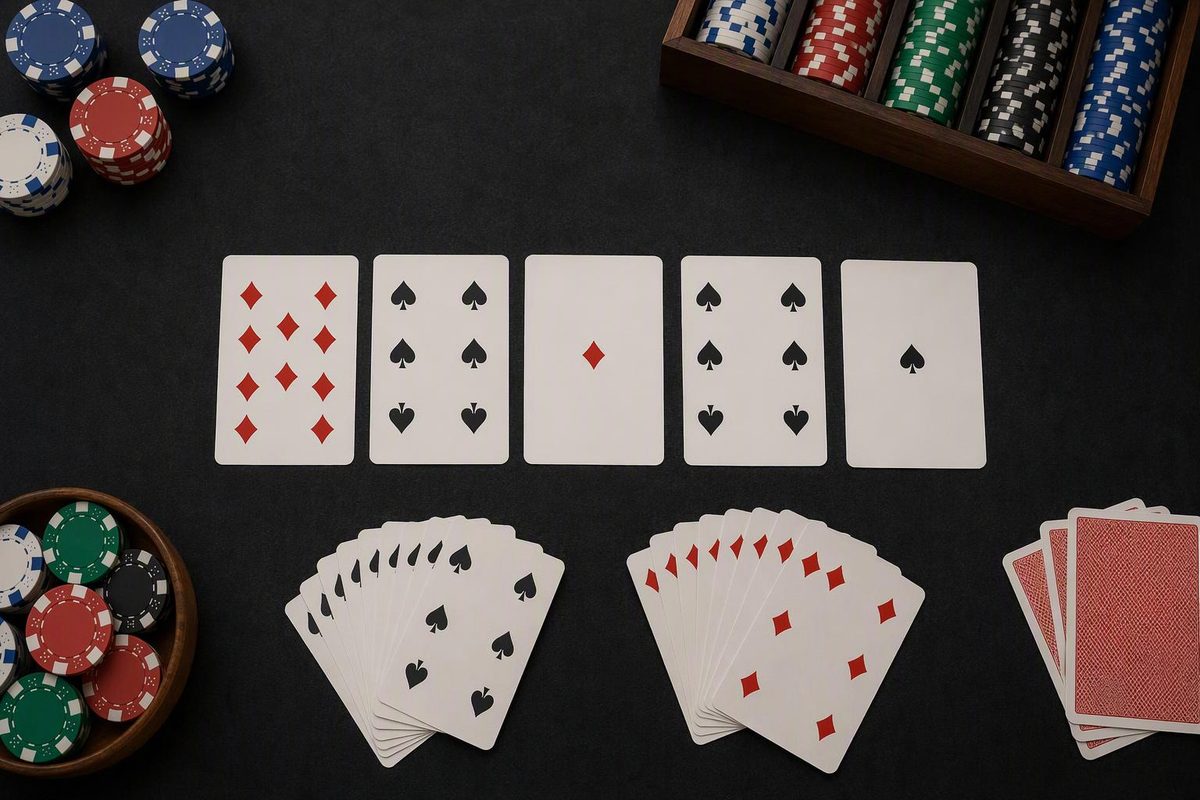
Probability measures the chance of a specified event. A probability distribution describes how that chance is spread across every possible value of a random variable.
For a poker player, “What is the chance I complete my flush?” asks for one probability. “How likely am I to see zero, one or two more hearts?” asks for a distribution. The same calculation can answer both.
What a distribution must include
A random variable assigns a number to each possible outcome. For example, let X be the number of hearts dealt on the turn and river. Its possible values are 0, 1 and 2.
A table giving the probability of each value is a discrete probability distribution. Every probability must be between 0 and 1, and the probabilities must sum to 1—100%. Those are the basic checks set out in OpenStax’s introduction to discrete distributions.
The function assigning each value its probability is called a probability mass function, or PMF. It can be presented as a table, graph or formula, as Penn State’s probability course explains. A table is often enough to make it useful.
One flush draw, three possible counts
Suppose you hold A♥ J♥ in Texas hold’em, and the flop is 8♥ 3♥ K♣.
You know five cards, including four hearts. Of the 47 unseen cards, nine are hearts and 38 are not. Assume a standard, fairly shuffled 52-card deck, no other exposed cards or information affecting the model, and that both remaining board cards are dealt.
We are counting hearts—not wins. PokerNews’s explanation of outs confirms that a four-heart flush draw leaves nine hearts to complete it.
There are C(47, 2) = 47 × 46 ÷ 2 = 1,081 equally likely unordered turn-and-river pairs. Here, C(n, k) means the number of ways to choose k items from n, ignoring order.
| Additional hearts, X | Number of card pairs | Exact probability | Percentage, rounded |
|---|---|---|---|
| 0 | C(38, 2) = 703 | 703/1,081 | 65.0324% |
| 1 | 9 × 38 = 342 | 342/1,081 | 31.6374% |
| 2 | C(9, 2) = 36 | 36/1,081 | 3.3302% |
| Total | 1,081 | 1 | 100.0000% |
These are direct combinatorial calculations under the stated assumptions. The rows do not overlap and cover every possible heart count.
Completing your heart flush requires at least one additional heart, so add the last two rows:
P(X ≥ 1) = (342 + 36)/1,081 ≈ 34.9676%.
Exactly one heart and at least one heart are different events. The distribution makes that distinction visible.
Why the cards are not independent
This is a hypergeometric distribution: a count of one type of item drawn randomly without replacement. Penn State’s probability course gives that definition and its combination-based formula.
The chance of a heart on the turn is 9/47. If the turn misses, the river chance becomes 9/46; if the turn is a heart, it becomes 8/46. The first card changes what remains, so treating both draws as independent trials with an unchanged probability is not exact.
The distribution also gives an expected heart count:
E(X) = 0 × 703/1,081 + 1 × 342/1,081 + 2 × 36/1,081 = 18/47 ≈ 0.3830.
That is an average across repeated deals under this model—not a possible result in one hand. Each individual runout produces zero, one or two hearts.
A flush probability is not equity
The 34.9676% figure measures flush completion, not your chance of winning. You could lose after making a flush or win without making one.
Equity is your mathematically expected share of the pot, given the hands or ranges being considered; PokerNews defines it in those terms. It includes your share of tied pots, not just outright wins.
Expected value instead weights the net chip gains and losses of an action by their probabilities. Calling costs and any further betting therefore matter; a draw probability alone does not establish whether a call has positive expected value.
For the next step from card counts to a decision, see our worked explanation of probability, equity and expected value.